Your First Afternoon at a Bowling Green
A first visit to a bowling green is easier when you know where to sit, what to watch and how to follow each turn without taking part.
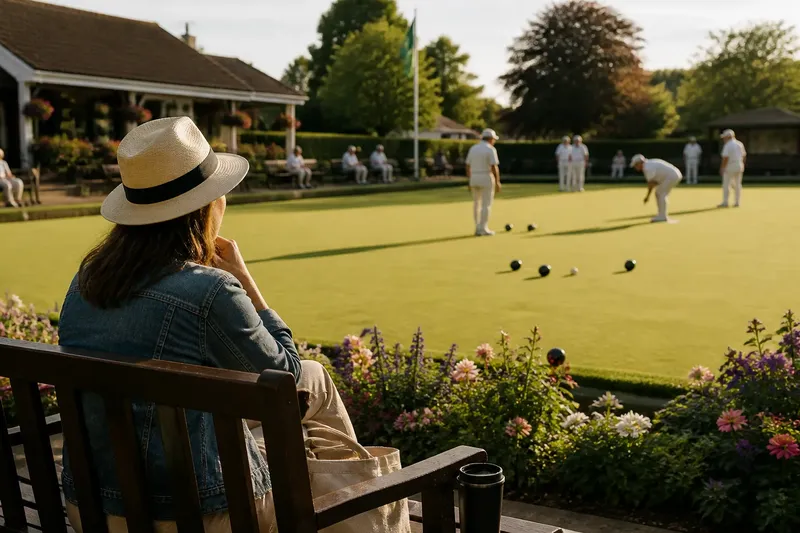
A first visit to a bowling green is easier if you treat it as a chance to watch the rhythm, not a test of sporting knowledge. Find a seat outside the playing area, ask a member where visitors should stand, and follow one end from its opening delivery to the players’ change of direction. You can enjoy the game without picking up a bowl.
Use the numbered points below as a loose plan rather than a schedule. A bowling club may have its own arrangements for spectators, refreshments and access, so ask before entering the green or moving around the rink.
1. Arrive with one simple question
At the clubhouse or entrance, tell someone plainly that it is your first visit and that you would like to watch. Then ask, “Where is a good place for a visitor to sit?” That question gives a volunteer or player a clear way to help without putting you on the spot.
Ask whether a match is under way, whether visitors may walk near the green, and where the spectator seats are. If the club is busy, keep your request brief and let people finish their current task. A noticeboard may show the day’s fixtures or explain where to check in, but a person can clarify local arrangements.
You do not need to know the names of every format before you arrive. If someone mentions singles, pairs, triples or fours, those labels describe how many players are on each side. The number of players can change how many bowls each person delivers, so it is fine to ask what applies to the game in front of you.
2. Choose a seat with a clear view and room to move
Look for a bench or chair beside the green, away from the playing surface and from the ends where players deliver their bowls. A useful seat lets you see the players, the target and at least part of the rink without making you feel that you are in the way. If the only open seat is close to a team, ask before taking it.
Stay off the green unless a club member invites you onto it. The playing surface is carefully maintained, and it is also part of the active match. Keep bags, drinks and phones beside your seat rather than on the edge of the rink. If you need to move, wait until no one is preparing to deliver a bowl, then use the route indicated by the club.
Think of the rink like a narrow shared path: a person already moving through it should not have to adjust for a spectator. Sit where players can see you, avoid standing directly behind someone about to bowl, and do not cross in front of a player’s line of sight.
3. Watch one end before trying to follow the whole match
A game is played in ends. At the start of an end, the jack is sent down the rink to become the target; players then deliver their bowls towards it. Rather than trying to track every player at once, watch one end from the first delivery until the teams agree which side has bowls closest to the jack.
The bowls are not designed to travel in a straight line. Their bias makes them curve, and players choose a line that brings a bowl towards the target from one side. Watch where a player aims, then notice the path the bowl takes. The difference between the intended line and the eventual position is part of what makes the game interesting.
At the end of play, the side with the bowl or bowls nearer the jack scores. In many formats, more than one bowl can count if they are all closer than the opponents’ nearest bowl. You do not need to judge close calls from your seat; listen for the players or umpire to settle the result.
4. Follow the turn-by-turn rhythm
Notice who delivers the jack, who plays first and how the teams alternate. The order depends on the format and can be explained by a player or club member. Once you know whose turn follows whose, the match becomes easier to follow even if you do not yet understand every tactical choice.
After the jack has been placed, each player takes a turn delivering a bowl. Players may pause to inspect the head—the group of bowls gathered around the jack—and choose a different line or weight. “Weight” means how far a bowl is likely to travel; a player may send one gently to finish close or with more force to disturb bowls already near the target.
Between deliveries, the person at the head may signal where a bowl has finished or indicate the preferred line. Watch for small gestures, but do not assume every signal has the same meaning at every club. The useful thing to notice is that players communicate to help their teammate choose a delivery, then give the next player space to play.
5. Listen for the score without needing a scorecard
After the bowls have been delivered in an end, the players determine which bowls count and record the score. The score may be called aloud, written in a scorecard or shown on a display. If you hear a number, it usually refers to the points awarded for that end, not the total number of bowls played.
To keep your place, remember just three things: which side won the latest end, how many points it received, and which direction the next end will be played. You can follow those details from announcements or a board. If you lose track, wait for the next score to be recorded rather than interrupting a player who is measuring or writing.
For instance, imagine you arrive while a pairs game is in progress and hear that one side has taken two shots. You could note that those are the points from the end just completed, watch the players move to the opposite end, and then follow the new end from its first bowl. That gives you a clear point to rejoin the match without needing to reconstruct what happened earlier.
6. Know when to ask and when to stay quiet
Bowls is a social game, but players need concentration during a delivery. Keep conversation low while someone is on the mat, preparing to bowl or watching a bowl travel. Applause or a brief comment after a good shot may be welcome, but avoid calling out advice or reacting loudly to a close result.
Save questions for a pause between ends, a break or a moment when a player has stepped away from the rink. A good question is specific: “Why did that bowl curve towards the jack?” is easier to answer than “Can you explain everything?” If the person is busy, thank them and ask a volunteer later.
Do not touch a bowl, jack or measuring equipment, even if it appears to be in the way. Players need the positions to remain unchanged until the end has been decided. If something seems to require attention, tell a player or official rather than handling it yourself.
7. Make the visit comfortable for yourself
Wear ordinary clothes that let you sit comfortably, and check the weather before leaving: an open green can feel different from a sheltered clubhouse. Bring a light layer if the afternoon may cool, and take water if the club allows it near the seating area. You do not need specialist clothing or equipment to watch.
Stay for one complete end if that is all the time you have. If you are enjoying the match, you can watch another, ask how long the session is likely to continue, or visit the clubhouse during a break. Leaving quietly between ends is easier than departing while a player is ready to deliver.
If a member offers to explain the game, let them know whether you want a brief description or a closer look at the rules. You can decline an invitation to play without giving a reason. Watching first is a perfectly useful way to decide whether you would like to return.
What should a first-time spectator know?
Do I need to understand the rules before I arrive?
No. Knowing that players send bowls towards a smaller target called the jack is enough to begin watching. Ask about the order of play or scoring when there is a natural pause.
Can I walk around the green during a match?
Use the club’s spectator route and stay outside the playing surface. If you cannot see a marked path or suitable place to stand, ask a member before moving.
What should I do if I cannot tell which bowl is closest?
Wait for the players or umpire to decide; close positions may need careful measuring. You can still follow the match by listening for the score and watching which side plays next.
Is it all right to leave before the game ends?
Yes. If possible, leave between ends and keep clear of players preparing to deliver. A quiet goodbye to the person who welcomed you is enough.
8. Leave with one detail to notice next time
Before you go, choose one thing that made the game clearer: the curve of a bowl, the way a team communicates, or how a score is settled. If you return, you will have a practical question to build on rather than a list of rules to memorise.
A first afternoon at a bowling green works best when you give yourself permission to watch at your own pace. Sit where you can see, respect the players’ concentration and follow one end at a time. The rest can come through observation and a few well-timed questions.