From Scorebook to Live Display: Keeping Track of a Game
Compare a sports scorebook and live display, understand what each records, and know how to check a discrepancy without mistaking a delay for an error.
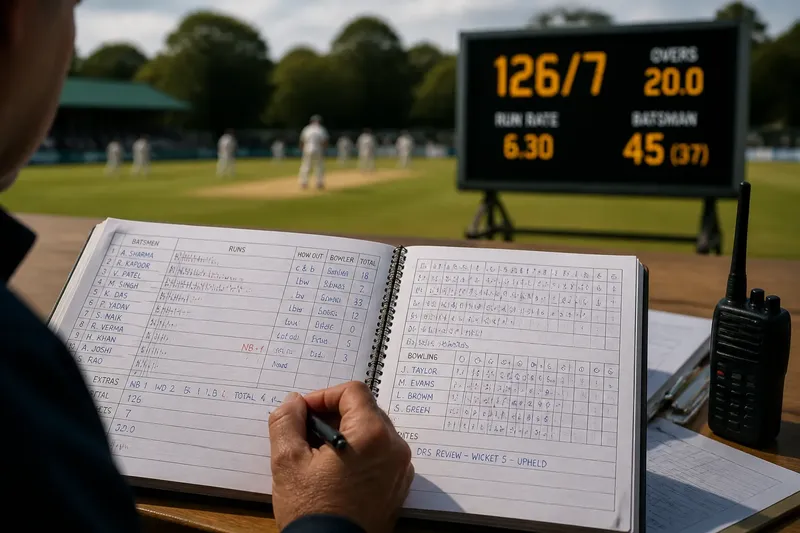
A sports scorebook and live display serve different purposes: one preserves a record, while the other shares selected updates. If the numbers disagree, compare the same confirmed moment and follow the event’s process before deciding that either is wrong.
A sports scorebook records the sequence behind the score
A scorebook can hold more than a running total. In cricket, for instance, a scorer may record runs, wickets, overs and how each batter was dismissed. In other sports, the sheet might track points, penalties, substitutions or periods. What belongs in the record depends on that sport’s scoring conventions.
That sequence can explain why a number on the board changed. A display usually answers the quick question, “What is the score now?” The book may help explain how the game reached that point, but it is still a record with a particular purpose, not a complete account of every moment.
Handwritten marks also make the scorer’s notation visible. A margin note, correction or symbol may indicate that an entry needed attention. Readers can interpret those marks only if the scorer uses them consistently and their meaning is understood.
A live display shows selected information at a glance
An electronic scoreboard often presents details such as the score, time, period, overs or names of players involved. Its size and position let people across a ground or hall see the same information without gathering around the scorer’s table.
Space is limited, so a display may show the current total but not the sequence behind it. It may also omit a detail relevant to the scorer or officials. A blank field does not prove that an event has not happened; the information may simply be outside the display’s chosen layout.
Think of the scorebook as a paper map and the display as a signpost at a junction. The signpost helps you orient yourself quickly; the map gives more detail about the route. Neither replaces watching where play actually goes.
Updates rely on people as well as equipment
Electronic equipment makes information easier to share, but someone still has to enter or transmit an update. The scorer, display operator and officials may have separate roles. When volunteers share those tasks, clear communication matters as much as a working screen.
If a call is under review or a score is being checked, the display may not change immediately. That pause may mean a decision is still being confirmed rather than that the equipment has failed. Wait for the officials’ signal or the event’s usual procedure before treating a changing number as final.
Imagine a community cricket match where the scorebook records a batter’s latest runs, but the display still shows the previous total. The scorer checks the relevant entry, tells the operator which total the event’s process calls for, and waits for the board to update. The observable result is that the display either matches the confirmed record or remains different, giving the scorer and operator a specific discrepancy to raise with an official. Until then, spectators can follow the play without assuming that either record is automatically definitive.
What should you check when the scorebook and display differ?
Which record is official for this event?
Some competitions name an official record or designated scorer; others set out a different process. Check the event instructions or ask an organiser which source governs the result. A public display is not necessarily the formal record.
Do both records show the same point in the game?
Compare the latest confirmed event in each record, not just the totals. A delay may explain a difference, particularly during a stoppage or review; if both records cover the same confirmed point, ask the scorer to check the entry.
Could a symbol or label be unfamiliar?
Scorekeeping abbreviations and symbols vary by sport and competition. Ask the scorer or consult the event’s explanation before treating an unfamiliar mark as an error.
Who should resolve a suspected error?
Raise the specific entry or display detail calmly with the scorer, official or organiser. Spectators can point out a discrepancy, but officials decide how the record is corrected.
Use the score as context for the action
A score can frame what you are watching, but it cannot explain every decision or passage of play. Notice who has possession, what the officials signal and how players respond. Those visible cues can help you understand why a total changes, while the book and display make different kinds of information available.
At a small event, ask where the score is recorded, learn the basic notation and give the scorer room to work. If you operate a display, confirm the event’s procedure before changing anything; equipment instructions and competition rules determine the right approach. For anyone comparing a sports scorebook with a live display, the useful distinction is that the book can preserve detailed entries while the board shares selected updates with the crowd.
When the board and book disagree, treat the mismatch as a reason to check, not as a verdict on the game. Leave the correction to the people responsible, and keep watching for the official signal that settles what the score means.