A Practice Session Needs One Clear Aim
A practice session with one clear aim gives beginners a manageable focus, a way to notice progress and a useful basis for choosing what to practise next.
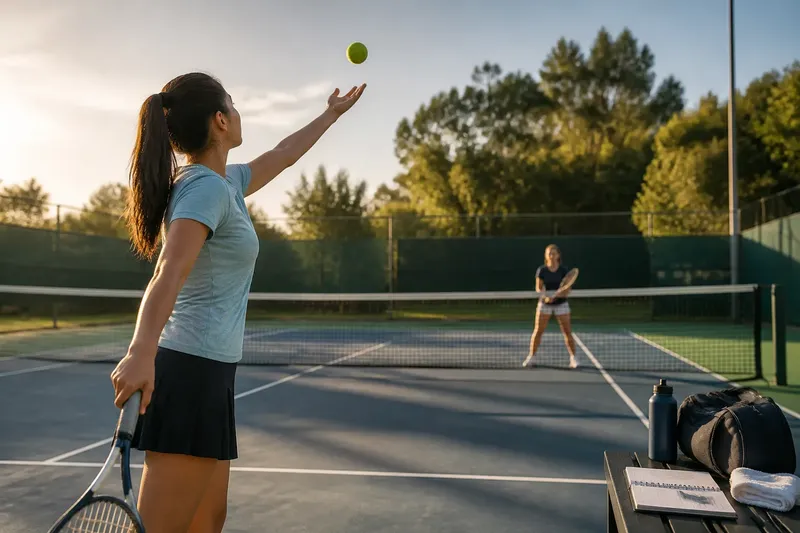
A practice session with one clear aim is easier to use than an hour spent trying to improve everything at once. If you are new to a sport, decide before you begin what you want to notice: a steadier tennis serve toss, a more balanced basketball lay-up approach, or a cleaner catch in softball. That purpose gives the session a shape without turning practice into a test.
The aim should describe an action you can see or feel, not a broad hope such as “get better”. It should also be small enough that you can pay attention to it while practising. The point is not to control every outcome; it is to make a useful choice, repeat the chosen action, and finish knowing what you learned about it.
A single aim gives practice a useful shape
Beginners often arrive with several reasonable ambitions. A tennis player might want to serve harder, keep the ball in, move better and feel less awkward. Trying to correct all of those at once can make each attempt harder to read: if the serve changes, it is unclear which adjustment mattered.
One aim narrows attention. Think of it like placing a bookmark in a book: it does not change the whole story, but it helps you return to the part you are working on. You can still warm up, take breaks and enjoy playing. The aim simply gives the main part of the session a centre.
Choose something that belongs to your control. “Make every serve land in” depends on more than your intention, while “start each serve with the ball held comfortably and the toss in front of my hitting shoulder” describes actions you can attempt. The result of a shot still matters, but it need not be the sole measure of whether the practice was worthwhile.
Make the aim small enough to notice
A useful aim has three features: it names a particular action, it can be observed during practice, and it fits the time and setting you have. “Improve my fitness” is too broad for one focused session. “Keep my knees softly bent as I receive a gentle forehand feed” is specific enough to check from one attempt to the next.
Keep the wording short. A long instruction can become another task to manage, especially when you are learning how a sport feels. Pick one cue, such as “watch the ball to contact” or “finish balanced”, and leave other possible corrections for another day.
Match the difficulty to your starting point. If the movement is unfamiliar, begin at a slower pace or with a closer, easier feed. If you can already perform it comfortably, add a modest challenge, such as a new direction or a more game-like starting position. The aim should invite attention, not require you to force a perfect result.
How do you choose and use one aim?
What makes an aim specific?
It names one action you can observe, rather than a general quality or final result. “Set my feet before returning a gentle ball” is easier to use than “play better”.
Should the aim be about technique or results?
For a beginner, a controllable technique cue is often easier to work with than a result that depends on several factors. You can still notice where the ball goes, but treat that as information rather than the only verdict on the session.
What if I cannot tell whether I am improving?
Make the task easier and use a simple observation, such as whether you stayed balanced after the movement. If the cue is still hard to judge, ask a coach or experienced participant to help you identify one visible detail.
Can I change the aim halfway through?
Yes, if the original task is clearly too difficult, too easy or unsuitable for the space. Make one deliberate adjustment and spend the remaining practice on the revised aim, rather than adding several new goals at once.
A hypothetical session turns a broad wish into a clear task
Say Mina is a beginner in tennis and has a court for a short practice with a friend. She arrives wanting to serve with more confidence, but that wish does not tell her what to focus on during each attempt. She and her friend choose a smaller purpose: begin each serve with a comfortable stance and send the toss in front of her hitting shoulder.
They start with an easy warm-up and a few unhurried serves. Mina pays attention to the stance and toss, not to adding speed. After each serve, she pauses briefly and asks whether the toss gave her room to swing. Her friend can offer a simple observation, but Mina remains responsible for noticing how the movement feels.
When the toss repeatedly drifts behind her, they do not add a new instruction about power or follow-through. They slow the routine and let her reset between attempts. Later, Mina tries a few serves with a normal rhythm, keeping the same cue. The expected observable result is not a flawless serve; it is a clearer distinction between tosses that leave room for a swing and those that do not.
At the end, Mina writes a short note: “Stance felt settled; toss in front was easier when I paused before starting.” This gives her a useful next choice. She might repeat the same aim until the movement feels familiar, or keep the stance and toss cue while practising at a slightly more game-like pace. She need not add serve speed as a second target in the same session.
Use the result to shape the next session
After practice, record what you attempted and one thing you noticed. Keep the note plain: “I stayed balanced on the slower feeds” is more useful than “I was bad today”. If the aim was too easy, choose a modestly harder version next time; if it was confusing, simplify the cue or ask for help.
Do not confuse a good session with a session in which every attempt succeeds. A useful outcome might be discovering that a cue is hard to remember, that a particular pace is too demanding, or that you need a coach to check your movement. Those observations help you choose a better task; they are not reasons to pile on extra goals.
Keep the aim flexible enough for the conditions. If a court is busy, a partner is unavailable, or the weather changes the plan, choose a safe version of the same action that suits the space. Follow the sport’s equipment guidance and local facility rules; for technique or injury concerns, seek advice from a qualified coach or health professional as appropriate.
A practice session with one clear aim gives you a practical answer to “What am I working on today?” Before your next session, write one short cue on a card or in your phone. Afterward, add one observation and use it to decide whether to repeat, simplify or gently progress the task. That small record turns practice into a series of choices you can understand and make for yourself.